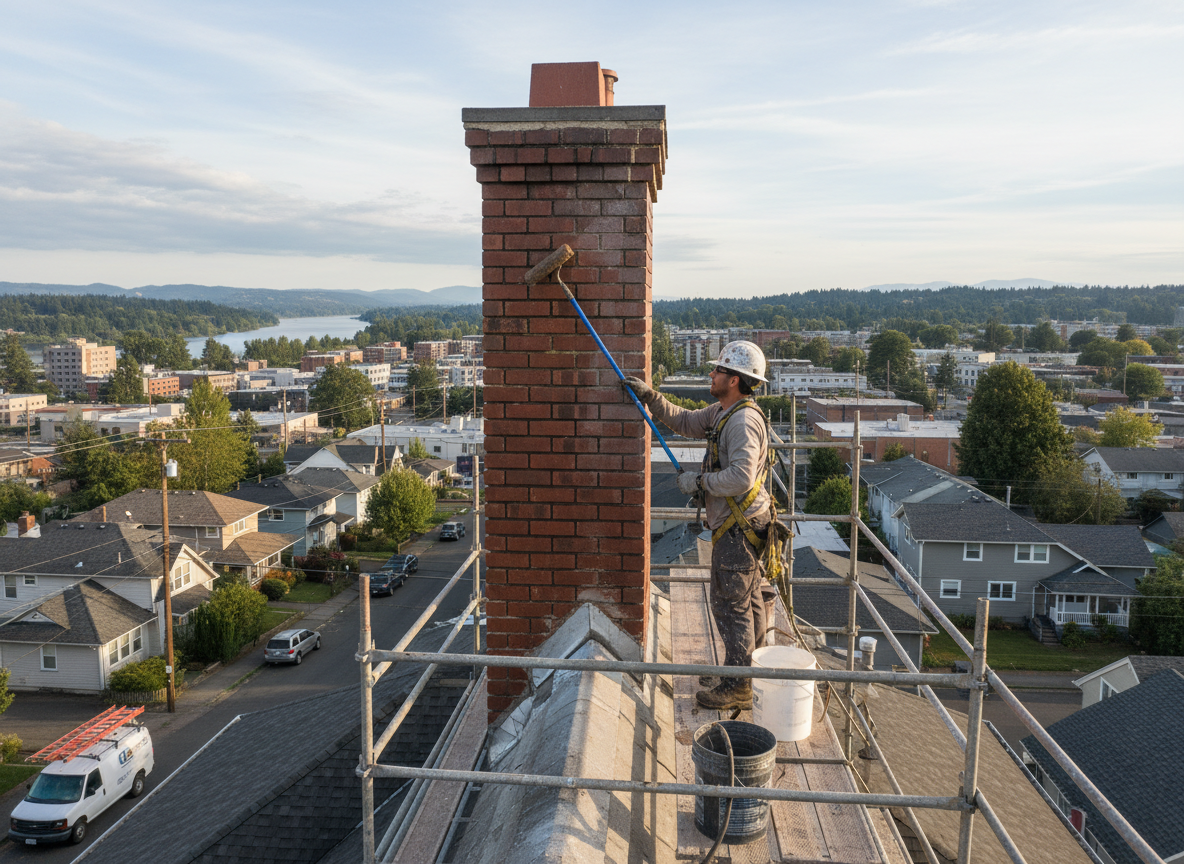
Milwaukie’s mild wet winters send repeated rain against chimneys on homes built before the 1970s in Downtown Milwaukie and Ardenwald. Water enters through hairline cracks in the crown and flue tiles, then migrates into the attic when warm dry summers finally arrive and the moisture expands. Standard paint-on sealers fail here because they cannot bridge movement in the brick caused by the freeze-thaw cycles that still occur on clear nights even in this climate. A two-coat masonry-grade silane/siloxane system applied after crown repair and flue cleaning is the only method that consistently stops the cycle in these older stacks.
Homes near the Willamette River in Island Station and Hector Campbell sit in higher humidity zones where fog lingers into the morning. That extra moisture load means the waterproofing must also protect the exterior brick below the roofline, not just the crown. We tape off cedar siding and aluminum flashing first, then work the product into every mortar joint with a brush so it penetrates rather than films. Skipping the joint work is the most common reason waterproofing jobs fail within two winters in this part of Clackamas County.
Clackamas County code requires that any chimney work visible from the exterior maintain the original appearance, so we use only clear penetrating sealers that leave no sheen. Homeowners sometimes attempt to seal from inside the flue with spray cans; those products never reach the exterior joints and can trap moisture inside the masonry, accelerating spalling. We always start with a camera inspection from the roof down to confirm the flue is clear before any product goes on.
Edge Cases We See in Milwaukie
Chimneys on split-level homes in Ardenwald often have offsets that create hidden ledges where water pools; these require extra attention during the cleaning step. River-adjacent properties can also have higher mineral content in runoff that leaves white efflorescence, which must be neutralized before the sealer is applied or the coating will not bond.
Technician insight
In Milwaukie, the thing that catches most people out with chimney waterproofing is how quickly river humidity in Island Station and Hector Campbell drives moisture into pre-1970 brick that never fully dries between the mild wet winters; homeowners often seal only the crown and miss the lower joints that are taking the brunt of the runoff.
Persistent Leak in Ardenwald Chimney
Homeowner reported water stains on the ceiling after several wet winters. Inspection showed open mortar joints and a cracked crown on a 1960s brick chimney. We repointed the joints, rebuilt the crown, and applied two coats of silane/siloxane sealer. The attic stayed dry through the following winter.
How it works
- 1
Roof-Level Inspection
We climb every chimney we treat and check crown condition, flashing, and brick joints while documenting any existing damage.
- 2
Flue Cleaning and Drying
Loose creosote and debris are removed so the waterproofing can reach the masonry; we wait for dry weather windows typical between May and September.
- 3
Crown and Joint Repair
Cracked crowns are rebuilt with matching mortar and open joints are repointed before any sealer is applied.
- 4
Two-Coat Waterproofing Application
Silane/siloxane sealer is brushed into every surface, allowed to absorb, then followed by a second coat once the first has cured.
- 5
Final Walk-Through
We review the finished work with the homeowner and note any future monitoring points around the Willamette River humidity zones.
Pricing
Upfront quotes after inspection; price depends on chimney height, number of offsets, and extent of joint repairs required.