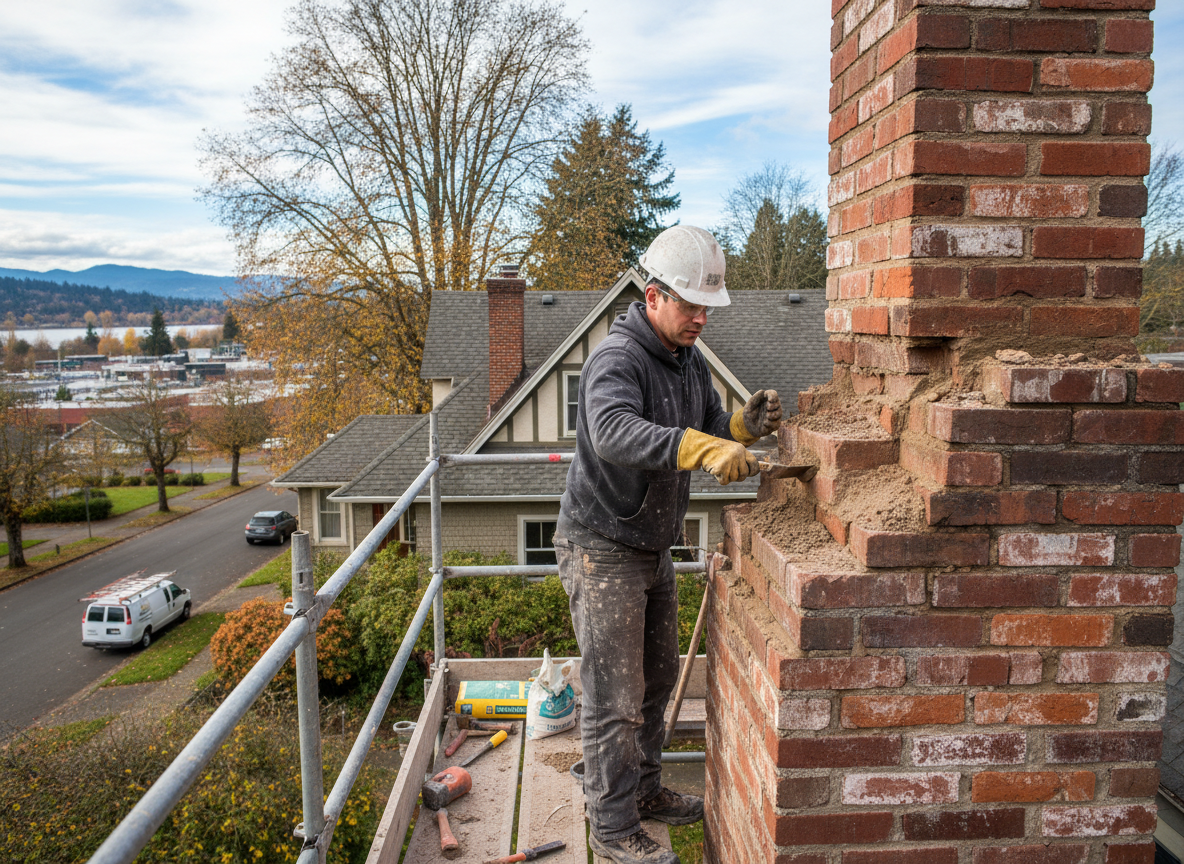
Chimney masonry in Milwaukie homes often shows deterioration from repeated rain exposure during mild wet winters. Older brick stacks in neighborhoods such as Downtown Milwaukie and Ardenwald sit close to the Willamette River, where constant moisture drives water into mortar joints and accelerates spalling. Repair work here requires removing failed mortar to sufficient depth, cleaning the joint faces, and installing new mortar matched to the original composition so the stack can expand and contract without new cracking. Edge cases include chimneys that lean slightly after decades of settling on Clackamas County clay soils; these demand careful repointing rather than full rebuilds unless the flue liner is also compromised.
Tuckpointing and selective brick replacement form the core of most jobs. Portland-area homes built before 1960 frequently used soft brick that crumbles when standard hard mortar is applied, so material matching is essential. Access on two-story homes in Island Station or Hector Campbell can involve scaffolding on narrow lots, and crews must protect nearby roofs from falling debris. Code notes in Clackamas County require proper flashing integration at the roofline during any masonry work to prevent future leaks. Homeowners should expect the work to take one to three days depending on height and the number of joints that need attention.
Dry summers allow scheduling without weather delays, yet the prior winter’s saturation means crews often discover hidden voids behind the face brick. These voids are packed with mortar or backer rod before final pointing to restore structural integrity. Ignoring them leads to rapid re-failure once rains return. Proper curing time is observed even in warm months so the new mortar does not shrink and pull away from the brick.
Seasonal Considerations
Masonry repairs completed before the wet season begins hold up far better because fresh mortar has time to cure fully. Waiting until November often means working around rain and results in longer cure times.
Technician insight
In Milwaukie, the thing that catches most people out with chimney masonry repair is how our wet winters push water deep into the mortar on older stacks in Ardenwald and Island Station. Homeowners often notice only surface cracks while the real damage sits behind the face brick where the clay soil holds moisture against the foundation. Skipping the step of packing voids before repointing means the repair fails the next season.
Water-Stained Chimney in Ardenwald
A homeowner in Ardenwald reported interior staining along the chimney breast after several heavy winter rains. Inspection showed eroded mortar joints and voids behind the brick on the north face. Crews cut out the failed mortar, packed the voids, and repointed with a lime-based mix matched to the original. The staining stopped and the stack remained serviceable through the following wet season.
How it works
- 1
Site Assessment
Technician inspects the full chimney height, checks for water intrusion paths, and documents loose or missing mortar in specific neighborhoods.
- 2
Material Matching
Samples of existing mortar and brick are taken so replacement materials match the original composition used in Clackamas County homes.
- 3
Joint Preparation
Failed mortar is cut out to adequate depth, joints are cleaned, and any voids behind the face brick are identified.
- 4
Repointing and Curing
New mortar is installed, tooled to match surrounding work, and allowed to cure before the stack is returned to service.
Pricing
Upfront quotes provided after on-site inspection; final cost depends on chimney height, extent of joint failure, and access constraints.