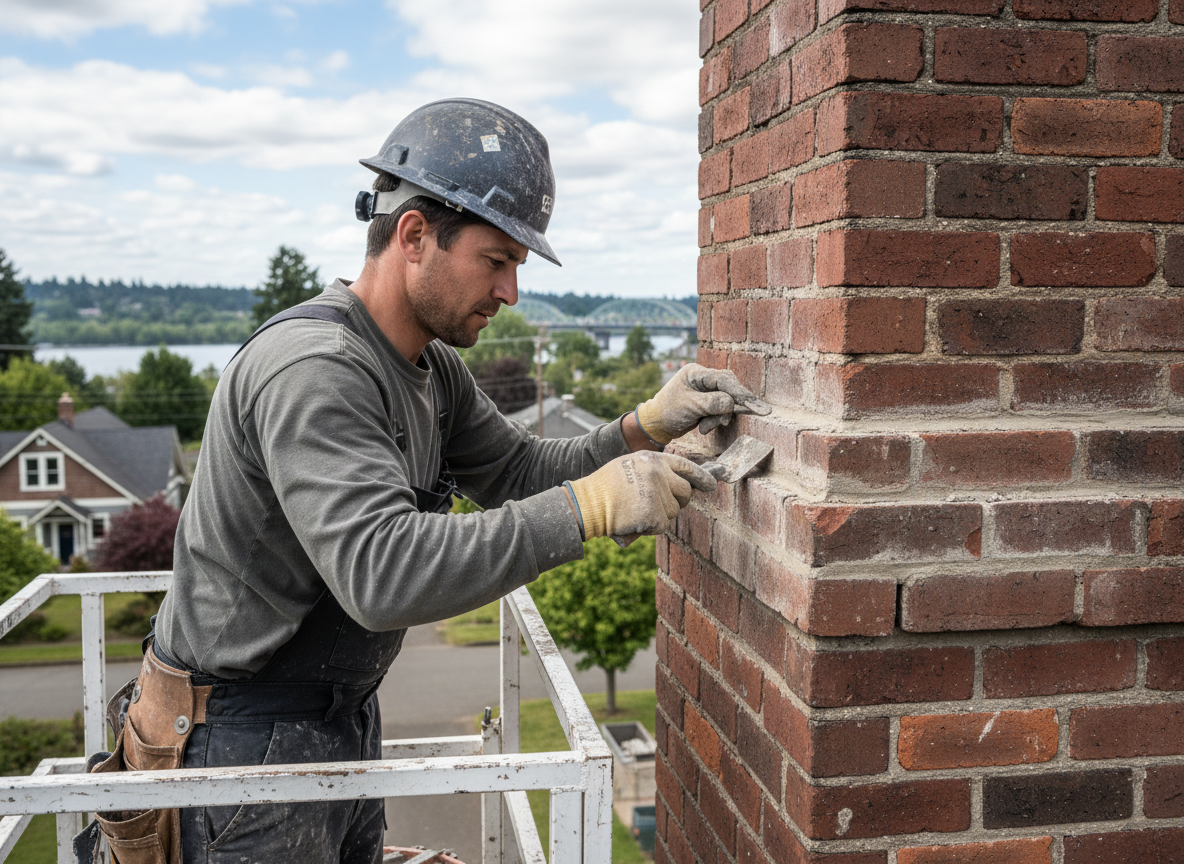
Tuckpointing on Milwaukie chimneys begins with removing failed mortar to a consistent depth without damaging the surrounding brick, which is often soft in pre-1960 homes found in Ardenwald and Hector Campbell. The area’s frequent winter rain and freeze-thaw cycles along the Willamette River accelerate joint erosion, so crews use lime-based mortars matched to the original composition rather than modern Portland cement that can trap moisture and spall bricks. Proper tooling leaves a concave profile that sheds water away from the joint face.
Edge cases appear regularly on chimneys serving Island Station and Downtown Milwaukie homes where rooflines intersect at odd angles or where ivy has pulled joints apart. In these situations technicians install stainless steel ties before repointing and apply a breathable water repellent only after the new mortar has fully cured. Skipping the cure time in Clackamas County’s damp climate leads to efflorescence that homeowners mistake for ongoing leaks.
Code notes for Clackamas County require that any work above the roofline maintain the original flue liner clearance; tuckpointing crews therefore document liner condition before scaffolding is removed. Homeowners in Portland-adjacent neighborhoods sometimes discover that previous cement patches have already cracked the flue tile, turning a simple tuckpointing job into a liner replacement once the chimney is opened.
Technician insight
In Milwaukie the thing that catches most people out with chimney tuckpointing is the amount of hidden damage behind the ivy that grows along the Willamette River. Older Ardenwald and Island Station homes often have multiple layers of mismatched mortar from past quick fixes, so what looks like a two-day job turns into four once the real joint depth is reached.
Ardenwald Chimney with Hidden River Moisture Damage
Homeowner noticed white staining on interior brick after heavy winter rain. Inspection revealed failed mortar on the west face where the chimney sat close to the Willamette River. Crews removed three layers of prior cement patches, installed new lime mortar, and added a drip edge at the crown. The staining stopped and the chimney passed inspection.
How it works
- 1
Inspection and Joint Mapping
Technicians examine every joint from the roofline to the crown, noting loose brick, water staining, and prior repairs common in older Milwaukie stock.
- 2
Mortar Removal
Old mortar is cut out to a uniform depth using handheld grinders fitted with diamond blades to avoid widening the joint or cracking adjacent brick.
- 3
Mortar Mixing and Placement
Lime-rich mortar is mixed on site to match existing color and hardness, then packed firmly into the joints in layers and tooled to shed water.
- 4
Curing and Final Check
The new mortar is kept damp for several days to cure properly in the local climate before the chimney is returned to service.
Pricing
Cost depends on chimney height, number of sides accessible, and extent of prior cement patches.